
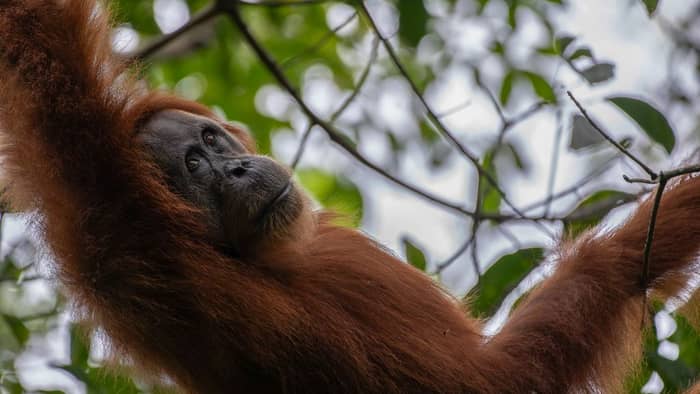
Bukit Lawang is a small village on the edge of Gunung Leuser National Park in northern Sumatra. It is one of the few places in the world where you can see Sumatran orangutans in the wild — no cages, no fences, in their natural habitat. Coming here means entering one of the oldest and richest ecosystems on the planet.
Gunung Leuser National Park
Gunung Leuser is one of three national parks that together form the Tropical Rainforest Heritage of Sumatra (UNESCO). Across more than 7,900 square kilometres, it protects one of the last large continuous tropical rainforests in Southeast Asia.
The park is home to Sumatran orangutans, Sumatran tigers, rhinoceroses, elephants, gibbons, macaques and hundreds of species of birds, insects and plants. The biological diversity is extraordinary — you can count more species of orchids on a single tree than exist in all of Europe.
Bukit Lawang is the most accessible gateway into the park. From here, trails lead deep into the rainforest — on day treks or multi-day expeditions with overnight stays at jungle camps.
What a jungle trek looks like
A typical day trek begins in the morning at the edge of the village. You enter the rainforest with your guide and within minutes find yourself in a different world — a dense green canopy overhead, sounds of birds and insects from every direction, the air warm and humid.
The guide watches for tracks, listens for sounds and knows where the orangutans tend to move. An encounter is not guaranteed — these are wild animals — but the experience of the local guides is such that the vast majority of treks end with an orangutan sighting.
Sumatran orangutans are calm and curious. When you come across them, they are typically sitting high in the tree canopy or moving slowly along branches. Females with babies tend to be more cautious, while flanged males with their distinctive cheek pads are imposing even from a distance.
Besides orangutans, you will likely see gibbons (you will certainly hear them — their calls carry through the forest for kilometres), macaques, Thomas’s leaf monkeys and, with some luck, other species.
A two-day trek adds an overnight stay at a jungle camp — a simple site with mattresses, mosquito nets and sarongs for cover. An evening by the fire, the sounds of the night forest and waking up to gibbon calls in the morning — this is an experience no documentary can replace.
Why go with a local guide
A guide is mandatory in Gunung Leuser. This is not just a regulation — it is a matter of safety and the quality of your experience.
Local guides in Bukit Lawang grew up on the edge of the rainforest. They know the terrain, the behaviour of the animals, they can navigate through dense vegetation and they know when and where to go. They can recognise orangutan tracks, identify medicinal plants and find a path where an outsider sees only a wall of green.
Our lead guide Ali Rusli has been guiding in Gunung Leuser for over twenty years. He knows the orangutan families in the park — he knows where each female with her baby tends to stay, which routes the dominant males take. This kind of knowledge cannot be gained from any guiding course.
What to bring to the rainforest
Preparing for a trek in a tropical rainforest is specific. Here is what matters:
- A small backpack for water and personal items. If it is not waterproof, line it with a plastic bag — your things will stay dry when it rains.
- Knee-high socks, ideally compression — they protect against leeches. Spray them with local repellent and leeches will mostly leave you alone.
- Long trousers — never walk through the rainforest with bare legs.
- Light shoes with a firm sole — the terrain is slippery and muddy. For women and children, the guide provides local rubber boots that are ideal for trekking. Men with shoe sizes above 42 (EU) should bring their own.
- A headlamp and power bank — there is no electricity in the rainforest.
- Insect repellent — buy it locally, it is significantly more effective than European brands.
- Breathable, quick-drying clothing — you will sweat. A lot.
Leeches, insects and what worries you
Leeches are part of the tropical rainforest. They are harmless but unpleasant. Knee-high socks and repellent are effective prevention. If a leech attaches, it is easy to remove — your guide will show you how.
Surprisingly, there are few mosquitoes in the rainforest. They are mainly active at dawn and dusk. The malaria risk in the Bukit Lawang area is very low.
Do not worry about snakes — they will not bite unless you try to grab them. Encounters with large animals (tigers, bears) are extremely rare. The animals notice your presence long before you notice theirs and they avoid you.
The most important rule: never leave the group and always follow the guide’s instructions.
How to reach Bukit Lawang
From Medan (the capital of North Sumatra) it takes approximately three to four hours by car to reach Bukit Lawang. The road passes through agricultural land and gradually climbs towards the edge of the rainforest.
Bukit Lawang is a small village — a handful of guesthouses, restaurants and shops along the Bohorok River. The infrastructure is simple, but that is part of the charm. In the evening you sit by the river, listen to the forest and prepare for the trek.
On a longer circuit around northern Sumatra, Bukit Lawang is usually the first stop — from here the route continues to Lake Toba and on to the volcanic landscape around Brastagi.
Practical tips
- Trek duration: A day trek takes approximately 5–7 hours including breaks. A two-day trek adds a night at a jungle camp.
- Physical difficulty: Moderate. The terrain is uneven and steep in places, but the guide sets the pace according to the group’s fitness.
- Feeding animals is strictly prohibited. It creates unnatural dependency on humans and can lead to disease transmission.
- Do not touch animals. Orangutans may look calm, but they are wild animals. Maintain a safe distance.
- Photography: Yes, but no flash and no noise. Keep your phone on silent.
- The jungle camp is equipped with mattresses, pillows, mosquito nets and sarongs for cover. You do not need a sleeping bag.