
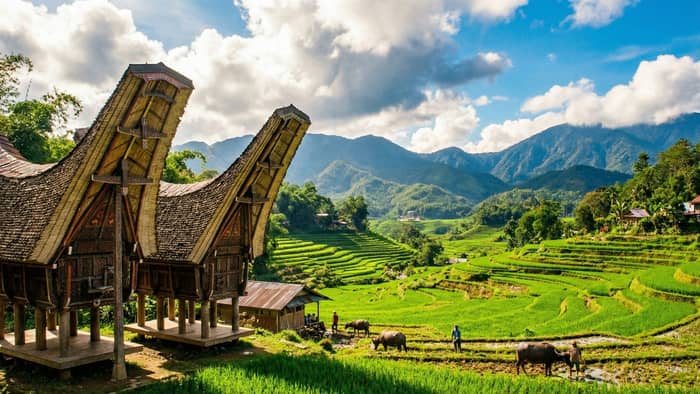
Tana Toraja lies in the mountains of South Sulawesi. It is a place where death is not an ending, but the beginning of a long and elaborate journey. The Toraja people maintain funeral traditions unlike anything else in Southeast Asia — rituals lasting days, rock tombs carved into cliff faces and wooden effigies guarding the dead. For travellers seeking cultural depth, Tana Toraja is one of the most powerful experiences Indonesia has to offer.
The land of the mountain people
The word “Toraja” comes from the Bugis term for “people from the mountains.” The Toraja live in a highland landscape of rice terraces, deep valleys and scattered villages, many of which are accessible only on foot.
The region has preserved a remarkably strong cultural identity to this day. While most Toraja have adopted Christianity, their original animistic rituals and customs endure and blend with Christian practice so naturally that the two form a single whole.
Funeral ceremonies — Rambu Solo’
Torajan funeral ceremonies (Rambu Solo’) are among the most complex ritual traditions in the world. A funeral is not a one-time event — it is a process that can span months or even years.
After death, the body remains in the family home, where it is cared for and regarded as “ill” (to makula). The family gathers resources for the funeral, as the ceremony is costly and its scale reflects the social standing of the deceased. Only when everything is ready does the actual ceremony take place.
The funeral ceremony lasts several days. Hundreds of people gather — relatives, friends, entire villages. The ritual includes the sacrifice of water buffalo and pigs, the number of which corresponds to the social status of the deceased. For the Toraja, this is not cruelty but a deeply rooted belief that the animals accompany the soul of the deceased to the afterlife.
As a visitor, you may be invited to attend a funeral ceremony — the Toraja tend to be hospitable and view the presence of outsiders positively. It is expected that you bring a small gift (typically a carton of cigarettes or a packet of coffee). Behaviour should be quiet and respectful, but the atmosphere of the ceremony is not sombre — moments of grief alternate with communal eating, music and storytelling.
Ma’nene — the washing of the dead
One of the most distinctive Torajan rituals is Ma’nene, which usually takes place in August. Families open the tombs of their ancestors, remove the bodies, clean them, dress them in new clothes and pose with them for family photographs.
To a Western mind this may sound unsettling, but in the context of Torajan culture it is an expression of deep respect and love. Death here is not a final severing of the relationship — it is simply a different form of presence. Ma’nene is a family gathering where the ancestors are still counted among those present.
Rock tombs and Tau-Tau
The Toraja bury their dead in rock tombs carved high into cliff faces. In front of the tombs stand Tau-Tau — life-sized wooden effigies representing the deceased. The statues have raised hands, as if greeting the living.
The most famous rock tombs can be found at Lemo and Londa. At Lemo, rows of Tau-Tau are arranged on a balcony carved into the rock face — the sight of dozens of statues gazing down into the valley is one of the iconic images of Sulawesi. Londa offers access to caves where bones and skulls are stored in coffins in various states of preservation.
Tongkonan houses
Tongkonan are traditional Torajan houses with distinctive saddleback roofs curving upward at both ends — resembling the bow and stern of a ship. The roofs were once covered with bamboo, today often with corrugated iron, but the shape remains the same.
The facades are decorated with geometric carvings and paintings in red, black, yellow and white — each colour carries symbolic meaning. Buffalo horns on the front pillar of the house indicate the number of buffalo sacrificed at funeral ceremonies, and thus the prestige of the family.
Tongkonan are not merely dwellings — they are the centre of family identity and spiritual life. Every extended family has its own Tongkonan, to which rights, obligations and rituals are attached.
Rantepao and surroundings
Rantepao is the main town in the Tana Toraja region and the natural base for exploring the area. The town itself is small and unassuming, but functional — you will find accommodation, restaurants and a market.
From Rantepao you set out on trips to surrounding villages, rock tombs, treks through rice terraces and — if your timing is right — funeral ceremonies.
The surrounding landscape is an experience in itself. Rice terraces cascade into deep valleys, lone Tongkonan houses stand on ridgelines, mist rolls between the hills and the air is cooler and cleaner than in the lowlands. Treks around Rantepao take you to villages where you meet farmers, craftspeople and families who have lived here for generations.
How to reach Tana Toraja
The most common route leads from Makassar, the capital of South Sulawesi. The drive takes approximately eight to ten hours — a long journey, but a scenic one. It passes through rice valleys, traditional villages and gradually climbs into the mountains.
Alternatively, you can fly from Makassar to the town of Palopo (on the eastern side of Toraja) and continue by car, shortening the trip.
On a longer circuit around Sulawesi, Tana Toraja combines naturally with the karst landscape of Rammang Rammang, Lake Tempe and the beaches around Bira.
When to go
Tana Toraja can be visited year-round, but the most funeral ceremonies take place during the drier season — roughly from June to September. Ma’nene rituals are usually held in August.
During the rainy season (November–March) the landscape is at its greenest and most photogenic, but roads can be more difficult.
Practical tips
- Respect is fundamental. Funeral ceremonies are real events for real families. You are not in a museum — you are a guest. Be quiet, photograph discreetly and always ask whether it is appropriate.
- Sacrificial rituals. Animal sacrifice is part of the ceremonies. If this is something you find difficult, that is entirely legitimate — but inform yourself beforehand so you know what to expect.
- Mountain weather. Rantepao sits at around 700 metres elevation. Mornings and evenings can be cool — bring a light jacket.
- A local guide is essential not only for navigation but also for access to ceremonies and communication with families.
- Gifts at ceremonies: A carton of cigarettes or a packet of coffee is a customary and expected token of respect.