
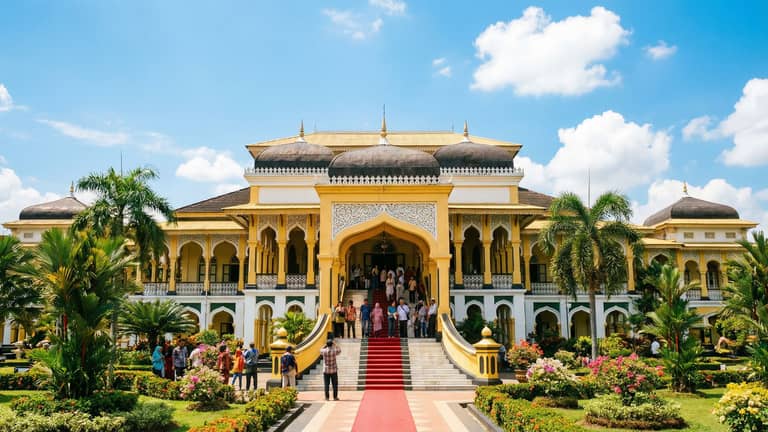
Most journeys across northern Sumatra begin in Medan. It is Indonesia’s fourth-largest city, home to roughly 2.8 million people, and the main entry point to the entire region. Many travellers fly in and immediately move on — to Lake Toba, to Bukit Lawang to see the orangutans, or to the highlands around Berastagi. We recommend giving Medan at least one day, though. The city carries a layer of history you won’t find elsewhere on Sumatra.
A city that is in no hurry
At first impression Medan feels busy and disordered, like most large Indonesian cities. Traffic is dense, the streets are full of mopeds, and the smell of street kitchens drifts through every corner. Beneath that surface, however, lies an interesting past. Medan grew at the end of the 19th century thanks to tobacco and rubber plantations, which drew in Dutch capital and traders from across Asia. From that era comes the city’s multicultural character — Malay, Chinese, Indian and Batak communities live side by side here.
For us, Medan is the place where a traveller adjusts to the pace of Indonesia before heading into quieter regions. It is a good introduction, not the highlight of the trip.
Colonial heritage
The Dutch era left behind a number of buildings in the centre that are worth a walk. You’ll find old trading houses, banks and administrative buildings from the turn of the century, many still in use. The best known is the former insurance company building and the area around Merdeka Square.
The architecture here is a blend — European restraint with tropical features, Chinese trading houses with richly decorated facades. A walk through the centre gives a sense of what a colonial trading city looked like, and of how many different influences met here.
The Maimun Palace and the Raya Mosque
Two structures stand out in Medan. The Maimun Palace, built in 1888, was the seat of the Sultan of Deli, and his descendants still symbolically reside here. The yellow facade, Malay arches and European and Indian elements make the palace one of the most interesting examples of sultanate architecture on Sumatra. Part of it is open to the public.
Nearby stands the Grand Mosque of Medan (Masjid Raya Al-Mashun), built in the same period at the same sultan’s initiative. It is one of the most beautiful mosques in the country, with Moorish, Indian and Spanish influences. The two buildings are a few minutes apart and form a natural pair for a half-day walk.
Where to eat
Medan has a reputation as one of the best places to eat on Sumatra. Several culinary cultures meet here, and the result is a varied street-food scene. We recommend trying the local noodle soups, Chinese-Indonesian specialities and tropical fruit — the area around Medan is famous for its durian.
Practical tips
- Length of stay: One day is enough to get to know the city. You’ll cover the main sights in half a day; spend the rest on food and a walk through the centre.
- Getting around: The Grab or Gojek apps are worth using for getting around the city — cheap, reliable and no haggling over the fare.
- Onward routes: From Medan there’s a natural route south to Lake Toba (via Berastagi) and west to Bukit Lawang. Our guides usually plan Medan as the start of the loop.
- Weather: Medan is tropically warm and humid year-round. Light clothing and water are essential.
- Airport: Kualanamu International Airport lies about 40 km from the centre, connected by both train and taxis.