
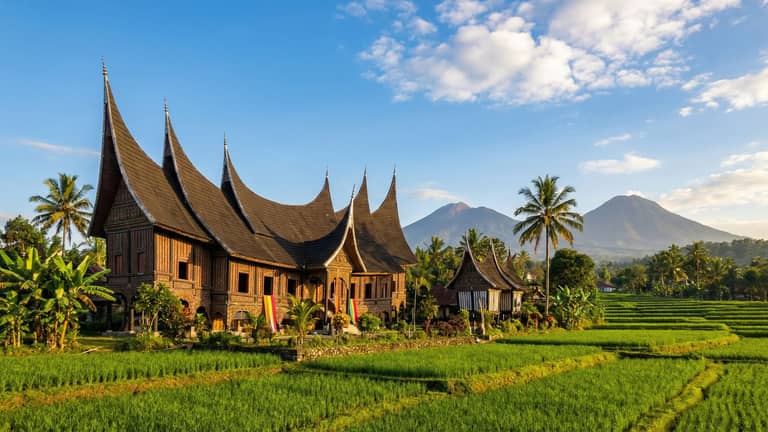
West Sumatra is home to the Minangkabau people — a community that is exceptional in many ways. It is the largest matrilineal society in the world: property, land and family homes are inherited through the maternal line, from mother to daughter. For a traveller interested in how differently human society can be organised, the area around Bukittinggi is one of the most fascinating places in Indonesia.
A matrilineal order
In Minangkabau society, the house and the land belong to women and are passed down the female line. Men traditionally leave home in adulthood — either to marry into their wife’s family, or to seek experience away from the village, a practice known as merantau. This migration in search of work and knowledge is still part of male Minangkabau identity, and it explains why people from this region are scattered across the whole of Indonesia.
What is interesting is that this matrilineal structure exists alongside a deeply rooted Islam. The Minangkabau are often described as an example of how adat (traditional customary law) and religion can complement one another without either pushing the other aside. It is a living balance, not a museum.
Rumah gadang — houses with roofs like buffalo horns
The visual signature of Minangkabau culture is the rumah gadang house. Its roofs rise into pointed peaks that recall buffalo horns — a reference to the legend from which the Minangkabau take their name (minang kabau means “victorious buffalo”). The traditional houses are made of wood, richly decorated with carvings and paintings, and serve as the ancestral home of an entire matrilineal line.
Many rumah gadang still stand in villages across the region. Some function as homes, others as a clan’s gathering place or a small museum. You’ll find the same horned roofs on newer buildings too — offices, schools and mosques — as a conscious continuation of the tradition.
The village of Pariangan
Pariangan, lying at the foot of the Marapi volcano, is regarded as the ancestral village of the Minangkabau and is often counted among the most beautiful villages in Indonesia. Traditional houses, rice terraces climbing the slope, an old mosque and hot springs create a picture that has changed little over generations. A walk through the village gives a sense of what rural Minangkabau life looked like long before the modern age arrived.
Padang cuisine
This region is the origin of Padang cuisine, one of the best known in all of Indonesia. Its principle is unmistakable: a row of small bowls with different dishes is set on the table, and the guest pays only for what they touch. The most famous dish is rendang — beef braised for hours in coconut milk and spices until it thickens and caramelises. You’ll find Padang restaurants throughout Indonesia and around the world, but here, in West Sumatra, you are at its source.
Practical tips
- Base: Bukittinggi is the natural starting point for exploring the region — a cooler highland climate and good access to the surrounding villages.
- Respect: When visiting villages and entering a rumah gadang, be considerate, dress modestly and ask before photographing people.
- Food: In a Padang restaurant you don’t need to order — the bowls arrive on their own and you pay only for what you eat. If you don’t eat spicy food, say so in advance.
- Onward routes: The Bukittinggi area combines well with Lake Maninjau and the Harau canyon. Our guides usually plan two to three days here.
- Getting there: From Padang on the coast, the drive to Bukittinggi takes roughly two to three hours, through a valley of rice fields.