
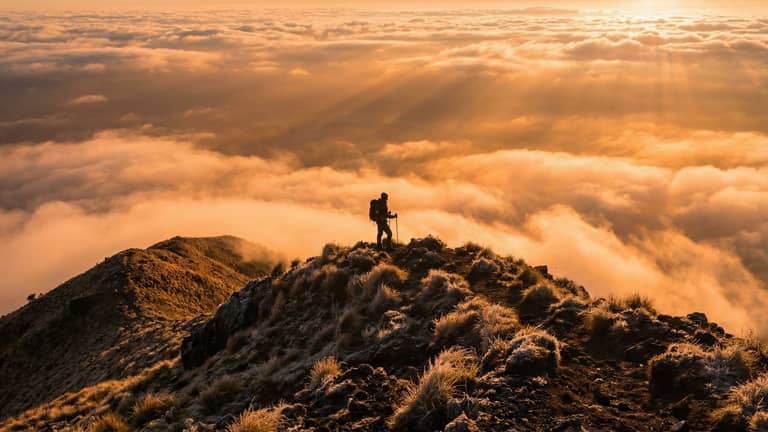
At 3,805 metres, Gunung Kerinci is the highest active volcano in Indonesia and the highest mountain on the whole of Sumatra. It rises in the middle of the Kerinci highlands, surrounded by Kerinci Seblat National Park and vast rainforests. Reaching its summit is one of the most demanding, but also one of the most powerful experiences Sumatra has to offer. It is not a walk for everyone — it is an expedition for travellers looking for something more than well-trodden tourist trails.
A two-day climb
The ascent of Kerinci is usually split over two days. On the first day you climb from the foothills through dense tropical rainforest up to a high camp, where you spend the night. The path through the forest is steep, humid and slippery in places, but this is where the mountain is most alive — birds, gibbons and insects call all around, and the vegetation changes with every hundred metres of altitude.
The second day begins while it is still dark. You set out from camp in the early hours so as to reach the summit by dawn. The final stretch leads across bare volcanic slopes, where nothing grows and a cold wind blows. It is the most physically demanding part of the entire route.
Dawn above a sea of clouds
The reward for the night-time climb is the view from the summit. In good weather, a sea of clouds spreads out below you, the peaks of the surrounding mountains rising from it, and the sun appears on the horizon. With good visibility you can see all the way to the coast of the Indian Ocean on one side and the inland rainforests on the other.
Kerinci is still an active volcano, so at the summit itself you can smell sulphur and see the crater. It is a reminder that you are standing on a living mountain — one of the many volcanoes that form the backbone of Sumatra.
What the climb involves
Climbing Kerinci requires a local guide and a permit to enter the park. This is not a formality — the weather on the mountain changes quickly, the path is not always clear, and local guides know the terrain, the campsites and a safe pace. Our partners in the area arrange guides, permits and equipment, and can adapt the expedition to the fitness of the group.
Expect cold at the summit even in the tropics — at night and around dawn, temperatures fall close to freezing. Good footwear, layered clothing and a headlamp are essential. The best season for the climb is the drier part of the year, roughly from April to October, when there is a better chance of clear skies above the clouds.
Practical tips
- This is a demanding climb — assess your fitness in advance and expect a long, steep day in the forest.
- A local guide and a permit are not optional; do not set out on the mountain without them.
- Pack warm layers and a waterproof jacket even in tropical heat — the summit is cold.
- Leave camp in the dark so you reach the summit by dawn, before the clouds move in.
- The best window is April to October; in the rainy season the summit is often in mist.