
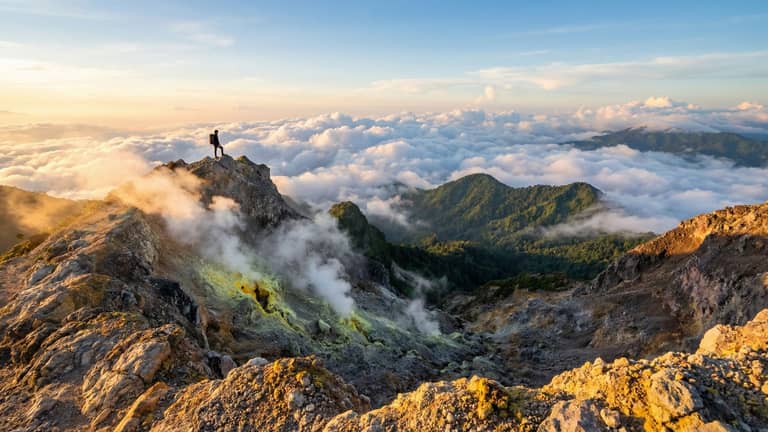
Two volcanoes rise above the town of Berastagi in northern Sumatra. The more accessible of them is Mount Sibayak (Gunung Sibayak), an active volcano 2,212 metres high. The climb to its summit is one of the most rewarding mountain hikes on Sumatra — it is not technically demanding, most travellers in reasonable shape can manage it, and the reward is a view straight into the crater, where sulphurous steam escapes from the cracks.
A mountain above the Karo Highlands
Berastagi lies in the Karo Highlands, where the air is cooler and the landscape greener than in the lowlands around Medan. It is a region of vegetable and fruit farms, markets and the Karo Batak people. For travellers heading from Medan towards Lake Toba, Berastagi is a natural stop — and Sibayak is its high point in the literal sense.
Sibayak is an active volcano, but it has long been quiet. Its last major eruption took place at the end of the 19th century. Today it shows itself mainly through fumaroles and hot springs, which make it a living yet safely accessible mountain.
The climb to the summit
There are several routes. The classic one leads from the end of the road through forest and then over rocky terrain to the rim of the crater. The ascent usually takes two to three hours one way, depending on the route chosen and your pace. The path is not technically difficult, but the final stretch is steeper and rocky — sturdy footwear is useful.
Many travellers choose an early-morning start in order to be at the summit by dawn. In clear weather a panorama opens up over northern Sumatra, the surrounding hills and, in the distance, the outlines of other volcanoes. Sunrise over the mountain landscape of the Karo Highlands is one of the region’s strongest experiences.
The crater, fumaroles and sulphur springs
The summit area of Sibayak is not a classic pointed peak but a jagged crater. Sulphurous steam with its characteristic smell escapes from cracks in the rock, the surrounding stones are stained yellow with sulphur, and the whole place feels raw and alive. It is a vivid reminder that you are standing on an active volcano.
After the descent, many people stop at the hot sulphur springs at the foot of the mountain. A soak in the warm mineral water is a pleasant way to end the climb, especially after an early start.
Practical tips
- When to set off: For sunrise, start in the dark, usually around two or three in the morning. We recommend going with a local guide — the route is hard to follow in the dark.
- Gear: Sturdy hiking boots, a headlamp, an extra layer (the summit is often cold and windy) and plenty of water.
- Fitness: The hike is accessible to most travellers, but it is not a stroll. Expect several hours of walking over rough ground.
- Weather: Mountains catch the clouds. The best views tend to come early in the morning; later the summit often clouds over.
- Onward routes: Sibayak fits naturally on the route between Medan and Lake Toba. Berastagi is a good place for one or two nights.